Medical Visa for India


A Medical Visa is issued to foreign nationals whose sole purpose of travel is to receive treatment at an established, recognized, or specialized hospital or treatment center in India. It also covers patients seeking care under traditional systems of medicine.
To apply, your treating hospital must issue you a medical invitation letter and an appointment letter in the format Indian missions require. This is where CureBridge comes into the picture. We help you prepare these documents correctly, so your application isn’t held up at the embassy or consulate.
Your Medical Visa will cover the exact duration of your treatment plan, up to a maximum of one year. As a default option, Indian missions typically issue a six-month, triple-entry Medical Visa. However, if your treatment plan runs longer, share your hospital’s treatment schedule with the mission. Validity can be aligned more closely with your actual treatment duration, up to that one-year cap.
Note
Default terms can vary by nationality. Our team can confirm what applies to your specific country before you apply.
Need help with your medical visa?
Connect with CureBridge
If your recovery takes longer than expected, your Medical Visa can be extended for up to one further year by the local FRRO/FRO (Foreigners Regional Registration Office), provided you submit a medical certificate from a hospital recognized by the Government, ICMR, NABH, MCI, or CGHS. (Our partner hospitals meet these accreditation standards, which keeps your extension straightforward.) Any extension beyond that additional year requires approval from India’s Ministry of Home Affairs directly.
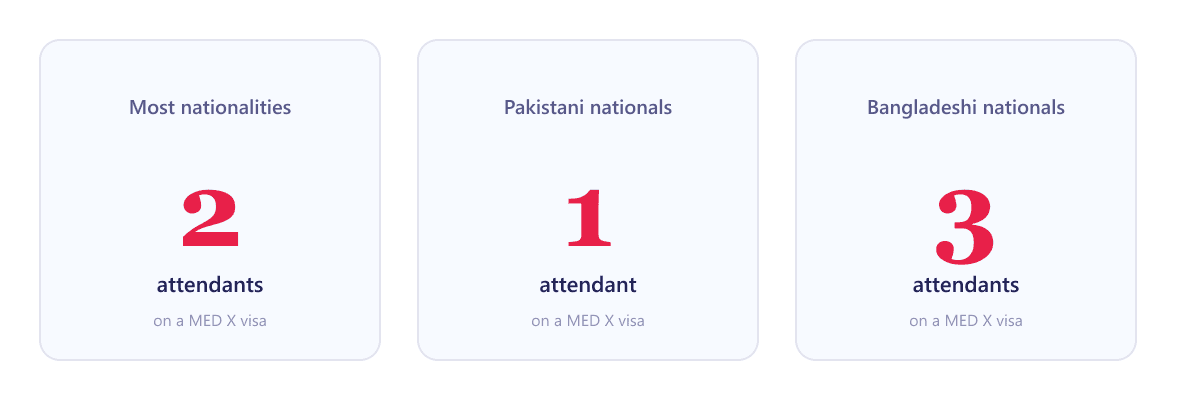
You don’t have to travel alone. A family member or attendant can accompany you on a Medical Attendant Visa (MED X), which runs co-terminus with your Medical Visa — meaning it starts and ends alongside yours. Minor children traveling with a parent who holds a Medical Visa are issued an ‘X-Misc’ visa, also co-terminus with the parent’s visa.
The number of attendants permitted depends on nationality:
Planning treatment in India?
Talk to CureBridge today
Registration requirements depend on your visa’s validity and nationality:
If your Medical or Medical Attendant Visa is valid for more than 180 days (and you’re not a Pakistani national), you must register with the FRRO/FRO within 14 days of arrival.
If your visa is valid for 180 days or less, no registration is required.
Pakistani nationals holding a Medical Visa must register within 7 days of arrival, regardless of how long the visa is valid for.
Pakistani nationals holding a Medical Attendant Visa must register within 24 hours of arrival, regardless of visa duration.
Country-specific rules
Visa validity, extension terms, and permitted entries for Pakistani and Bangladeshi nationals are governed by separate, specific provisions rather than the general rules above. If this applies to you, our team will walk you through the exact requirements for your nationality before you apply.
Sometimes the need for treatment comes up after you’ve already arrived in India on a different visa. In such a case, the process depends on your current visa’s duration:
If you hold a long-duration visa (6 months or more):
A minor condition needing only outpatient consultation doesn’t require any visa conversion.
Need unexpected, ongoing treatment while you’re here? If it’s under 180 days (or within the remainder of your stay), you or your hospital can reach out to the FRRO for a Medical Permit. It’s a limited-duration permission to be treated, backed by a medical certificate from a Government/ICMR/NABH/MCI/CGHS-recognized hospital. Importantly, this doesn’t cancel out your original visa. It stays active in the background and resumes once you finish treatment.
If treatment is expected to exceed 180 days, the FRRO will convert your original visa into a full Medical Visa (suspending, not cancelling, your original visa) and extend it under standard Medical Visa rules.
Dependents of the visa holder don’t always need to formally convert to a Medical Attendant Visa. The FRRO can permit them to stay as attendants without conversion, at their discretion.
Once you’ve recovered, the FRRO can revert your Medical Visa to your original visa without changing its original expiry date. However, this reconversion carries a fee equivalent to a fresh primary visa.
Both you and your treating hospital share responsibility for notifying the FRRO. The hospital reports treatment details through a Form C submission.
If you hold a short-duration visa (under 6 months):
The routine is mostly the same, with two big catches. Switching over to a Medical Visa cancels your original visa outright. Plus, after you’ve recovered, you’ll receive an exit permit to leave India rather than getting your old visa back.
If you hold an X-1 or X-2 visa (Person of Indian Origin, OCI cardholder, or spouse of an Indian citizen/OCI cardholder):
You can receive treatment in India for any duration, with no visa conversion and no FRRO permission needed at all.
CureBridge helps simplify the coordination involved in travelling to India for treatment. Depending on your case, our support can include:
Helping you identify suitable treatment options through partner hospitals
Coordinating with the hospital regarding your medical evaluation and treatment plan
Helping arrange the hospital documentation required for the visa application
Guiding you on Medical Visa and Medical Attendant Visa requirements
Helping coordinate documentation for accompanying family members
Supporting communication between you, your family and the hospital
Helping you understand the practical steps involved before travelling to India
Important
CureBridge does not issue Medical Visas. Our role is to help patients and families prepare and coordinate the healthcare-related aspects of their journey.
Share your reports and we will help you plan the treatment, the hospital documentation and the medical visa paperwork.
FAQ’s
The questions international patients ask us most about the India Medical Visa.
Can I combine sightseeing with my medical treatment on a Medical Visa?
How many family members can travel with me?
Do my children need their own visa?
What if my treatment takes longer than planned?
Do I need to register with the government after I land?